Prof. Xuhai Tang
Xuhai Tang is a professor at Wuhan University. He received his PhD from Imperial College London and was a postdoctoral researcher at Princeton University. He serves as an editorial board member of the International Journal of Rock Mechanics and Mining Sciences, and as an associate editor of Intelligent Geoengineering.
His research focuses on developing multiscale experimental techniques and generative physics-informed AI to continuously uncover new knowledge about geomaterials on Earth and in deep space. These advances support applications in geophysical exploration, hydraulic fracturing, geological hydrogen extraction, carbon dioxide sequestration, and drilling on the Moon and Mars.
__________
xuhaitangtech@gmail.com
Employment
2017–Present Professor, Wuhan University
2017 Visiting Professor, Lawrence Berkeley National Laboratory
2016–2017 Research Fellow, Wuhan University
2016 Visiting Professor, Monash University, Australia
2014–2016 Research Fellow, Princeton University, USA
Education
2010–2014 Ph.D., Imperial College London, UK
2006–2010 M.Sc., Sichuan University
2002–2006 B.Sc., Sichuan University
Academic and Professional ServiceEditorial Board Member, International Journal of Rock Mechanics and Mining Sciences
Guest Editor, Rock Mechanics and Rock Engineering
Guest Editor, Engineering Analysis with Boundary Elements
Associate Editor, Intelligent Geoengineering
Mineral-Rock Physics & Planetary Rock Mechanics
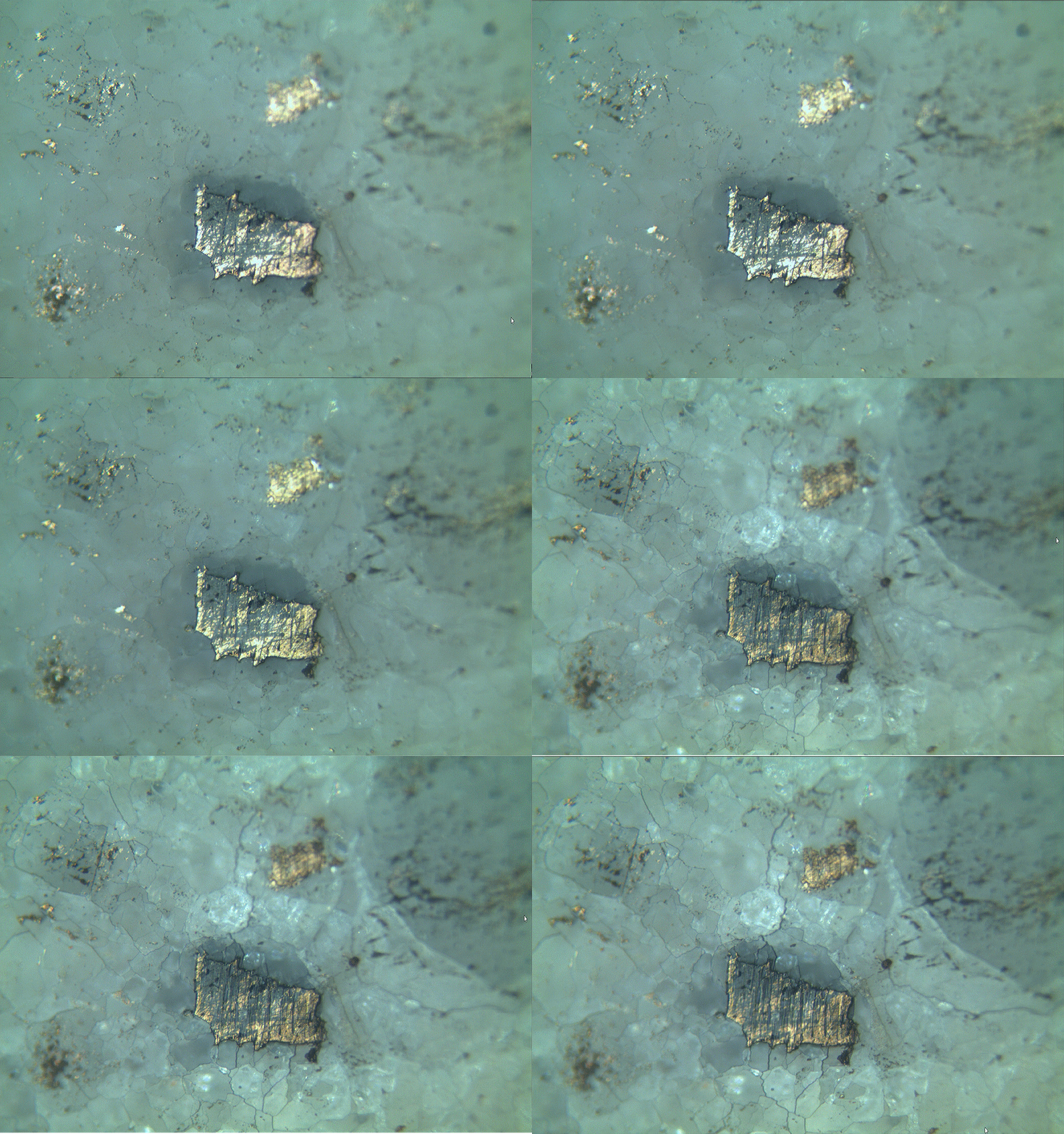
We developed a microscale rock mechanics experiment (micro-RME) system to characterize rock-forming minerals. In parallel, the accurate grain-based model and high-resolution AI-generated digital rocks were developed to elucidate the relationship between minerals and rocks. This system is particularly well suited for testing small and rare rock samples. Building on this capability, we have established a large database encompassing deep-Earth cores, meteorites, lunar regolith, and other relevant materials.
AiFrac - Combining Generative AI Physical Modelling
With the combination of physical simulation and machine learning, the Aifrac simulator is developed to create the digital twin of reservoirs according to monitoring data. Advanced numerical algorithms, such as FEMM and phase field method, are developed to model the hydraulic fracturing. This achievement contributes to smarter energy oil/gas production and space exploitation.